
It is not often that I make use of the various rideshare apps like Uber or Lyft. Growing up in the Inland Empire, the parts of Southern California that exist outside of more metropolitan areas, meant learning to drive young and spending hours and hours of adulthood sitting on concrete highways. Only if I am flying out to a city without personal contacts to pick me up, with the exception of Portland (where I am writing from now) because of their exceptional public transportation system, will I re-download one of these apps. Because of my own previous long term commitments to grueling commutes, I have a lot of empathy towards the experiences of these drivers– spending long hours sat rigidly in not-so-well cushioned car seats, eating meals on the road (I have my own trash bag situation to collect the forever accumulating cups and wrappers), and watching your paycheck get guzzled by your engine.
What I can only have sympathy for is that experiences accumulate to make up one’s working conditions when driving strangers around becomes a source of income by way of these gig-based rideshare apps. Self Driver takes the frustrations caused by these conditions and elevates them into an edge-of-your-seat thriller and asks the question of how far one will go for the paycheck.
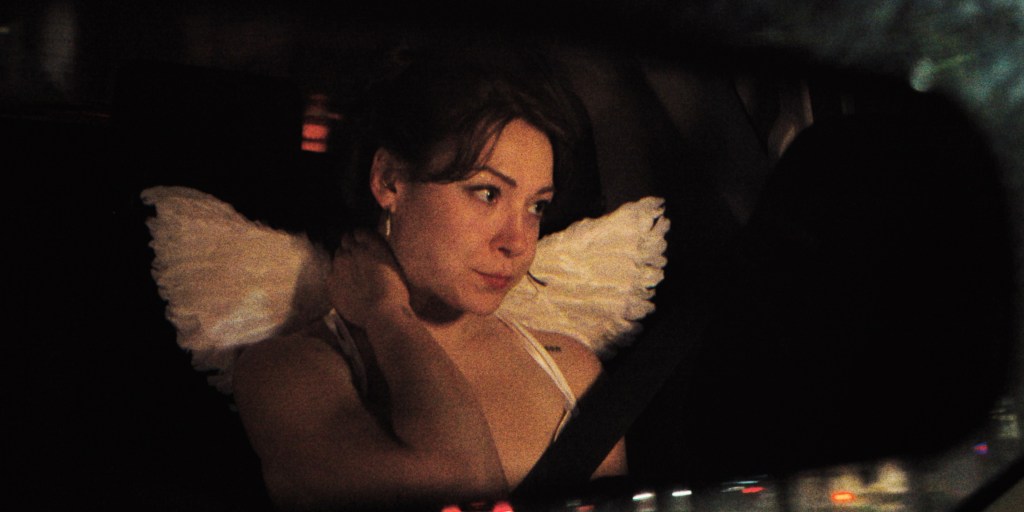
D (Nathanael Chadwick) is a driver for a fictional rideshare app, Vrmr, which has become his main source of income after being laid off from his day job. Supporting a partner and newborn baby, while also receiving endless calls from his landlord, D is strapped for cash. When a passenger picks his brain about his experiences as a driver, and offers him a gig with a start up for an all new and one of a kind rideshare app–with an insane payout promise–D is hooked. His orientation, however, is short, bittersweet, and above all else, strange. Drivers are not permitted to talk to their customers–a stipulation that could be a relief for some of us who find these obligations to engage in small talk to be rather annoying, but it is nonetheless an odd request. Drivers, despite the promise of quick cash, can quickly see deductions if mistakes are made and instructions not followed to a T–a tough ask when the GPS is mapless and directions vague. The biggest threat to the autonomy of a gig-based employee is the inability to turn down an assignment–once a ride is rejected, you are done for the night. With this final demand, each ride D accepts pushes moral boundaries further and further, causing him to continuously renegotiate his personal values against the value of quick cash.
Filmed on the late-night city streets of Toronto, there is so much texture and palpability captured through Self Driver’s guerrilla-like cinematography. Almost every angle, filmed with digital Sony cameras, is positioned within the vehicle. This not only allows the viewer to be up close and personal with D, but to see this underground world through his eyes, filtered through windshields and rear view mirrors. The viewer is just as clueless as D, and we are never sure what might lay around the next turn, allowing a film with such a simple premise to deliver forever escalating tension. He may be in the driver’s seat, but he is never in control. While we secretly wish to see how the next ride will up the stakes, we also find ourselves begging D to take back the wheel.
Finding out where the boundary sits for how far one will go when it’s all part of the job will forever be the most intriguing psychological experiment. While it never dips too far into the extreme, there are key moments that leave you uneasy. Each passenger could have led D down a different avenue, and the story could have unravelled into any number of twilight nightmares. But less is more in Self Driver, and its anchorage in reality keeps us focused on how scary it is to live in a late-stage capitalist world where every person you encounter is a commodity, and each life has its own price tag.
 Siren Death Cult