
Guilt and sin are poisonous elements ingrained into the soil of America. In a true Southern Gothic fashion, Ryan Coogler’s Sinners is a tale of sinister events that are bred from poverty, alienation, and violence. Set in the Jim Crow era Mississippi delta, the birthplace of post-Confederate disenfranchisement of Black Americans, the bitterness left by Reconstruction is a backdrop for a vampire tale that explores love and hate, race and class, power and money, and–above all else–music.
Over the course of a single day, smooth-talking twins Smoke and Stack (both portrayed by Michael B. Jordan) venture around their hometown of Clarksdale, Mississippi to enlist an entourage of old friends to employ for the opening night of their own juke joint. The twins’ little cousin, Sammie Moore (an astonishing debut for Miles Caton), is not only a sharecropper who works tirelessly early in the morning and the son of a preacher, but a beyond talented musician eager to follow his big cousins around town, enticed by their slick suits and tales of shenanigans in Chicago. Sinners is a film that is split into two parts, with the first half being a quaint stroll through everyday life in Clarksdale. Coogler carries the viewer through the dirt roads at a steady pace and introduces us to the folks that make up the heart and soul of the South. This tour around town introduces us to an endearingly drunk Delta Slim (Delroy Lindo), business savvy grocery store owners Grace (Li Jun Li) and Bo Chow (Yao), an old friend affectionately referred to as Cornbread (Omar Benson Miller), and each of the twin’s respective ex-lovers, the local root woman Annie (Wunmi Mosaku), and Mary (Hailee Steinfield), who is back in town for her mother’s funeral. Each character represents a small vignette of the life the twins left behind. However, instead of relying on exposition or flashbacks, the deep history that exists between them all is translated through careful glances, sly remarks, and insane performances all-around. We are so beautifully immersed into this world that it is easy to forget that once the sun sets on the rows of cotton fields, a night of bloodshed awaits.
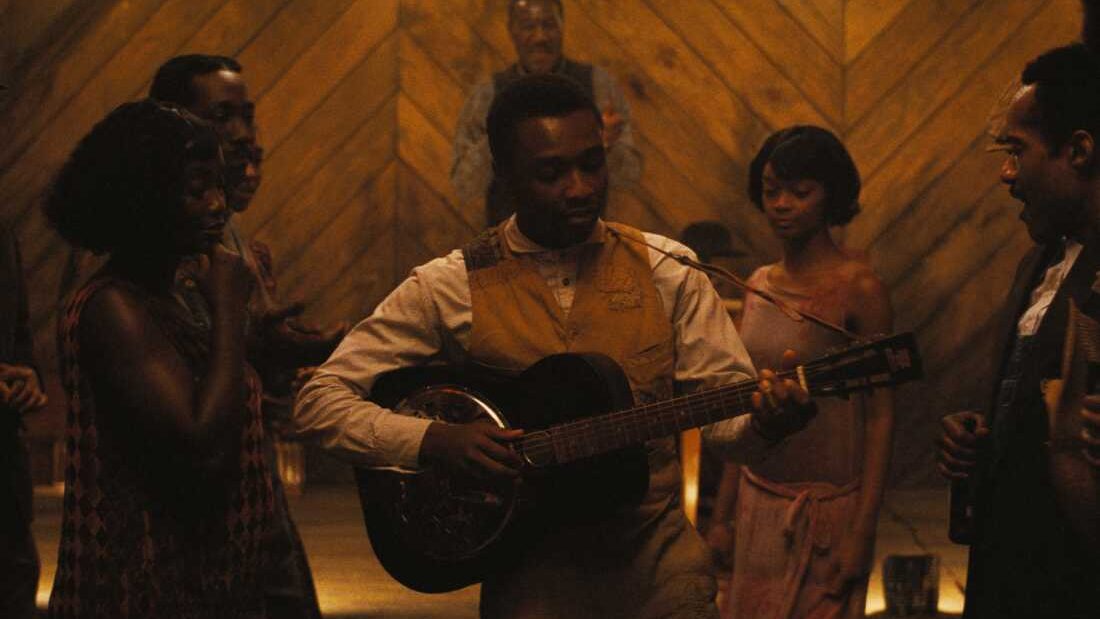
The centerpiece of Sinners is an intoxicating musical performance delivered by Sammie. This moment in the film is transcendent, piercing the veil not only between past and present, but the present and future–illuminated by Ludwig Göransson’s ambitious score. Rhythmic blues evolves into a dance between electric rock ‘n’ roll, R&B, and more. As the opening sequence suggests, this moment is so pure it unknowingly invites evil. Juke joints, like the one that houses this unforgettable sequence, were important cultural havens for freedmen during this period of history. Barred from entering white establishments under Jim Crow segregation, these joints were where sharecroppers and plantation workers were able to experience joy and relaxation. However, joy invites hate. Sammie’s music catches the attention of Remmick (Jack O’Connell), an Irish-immigrant and vampire. Once Remmick shows up demanding entry, the horror ensues. Although his intentions are perhaps ancient and motivated by appetite rather than earthly ignorances, he still represents the common threat of a white invasion into Black spaces and the tendency for bigotry to act quickly to invade and dismantle any semblance of joy that might emanate from the disenfranchised. Music in Black communities, since the birth of the blues, has historically been used as a form of resistance. This resistance then becomes the fuel for a predator ready to poach.
Mary’s presence is a reminder of the rigid, yet ever-evolving, construction of race in the United States. Hailee Steinfeld perfectly portrays a woman with a fractured identity caused by these racial lines. Mary, multiple times throughout the film, passes as a white woman but it is revealed that her mother’s father was half-Black–something that indicates that even though she has married a white man and can move through the world as a white woman, she is not truly safe if the wrong person decides it so. In the 1930’s, wherever the reach of Jim Crow laws stretched, racial integrity laws ranged from “one-eighth” to the “one-drop rule” which means that Mary’s race could change just based on what state line she crosses. When she is with white folks, she could be considered a Black woman, but when she comes waltzing up to Stack, many wonder if she is in the right place. This makes it all the more interesting that Mary’s meeting with Remmick and his crew of ex-Klan vamps is the incident that invites the massacre.

Vampires are timeless supernatural creatures that often represent conflict between the “Old” and “New” worlds, and nowhere has that conflict been more present than in a post-Antebellum South–so full of people desperately looking for their freedom but hindered by a society that did not want to let go of the keys to their chains. Aside from the excellent casting of O’Connell, who has Irish blood on his father’s side, the choice to make the monster of Sinners an Irish vampire adds to the intricacies in Coogler’s representation of racial and class tensions. Although Irish immigrants have a history of “otherness” in the United States and were considered lower on the pecking order economically, this doesn’t mean that Irish and Black Americans were considered allied forces. This is not to make accusations of racist tendencies in Irish folks, but to highlight that race plays an important role in class solidarity. From the days when low wage indentured servants, like many Irish immigrants, lamented that their opportunities were hindered by the availability of slave labor, to the way employers utilized African American scabs to cross slaughterhouse picket lines, and still the dangerous rhetoric used by the current administration–whiteness has always been a construct weaponized for an “us versus them” mentality. Poor white Americans often fall victim to ideologies that cause them to prioritize their white identities and end up viewing exploited minorities as their enemies rather than the slaveholders, capitalists, and CEOs.
With the weight of all of this coming into the movie theatre, Sinners is an exhilarating and soul-stirring vampire flick that forces viewers to come face to face with the monsters of our past, present, and future. In an exemplary entry into the Southern Gothic canon, a supernatural threat and the presence of Klansmen illuminates the way racism haunts the delta. Hatred, devilry, and greed are always on the heels of those just trying to live their life freely. Historical drama and vampiric horrors collide in a cinematic experience that must be seen.
 Siren Death Cult